
Science
SUMMARY
Biotechnology | Clinical Science | Epidemiology | Evidence Synthesis | Funding Proposals | Life Sciences | Problem-Solving | Regulatory Compliance | Research Methodology | Real-World Evidence (RWE) | Scientific Inquiry | Translational Research
Biobehavioral research scientists with exceptional scientific inquiry skills and 18+ years experience:
- Investigating cardiometabolic disease, pathophysiology, prevention, and management.
- Consulting with academic and industry partners on research development, management, and leadership.
- Leading and mentoring large research teams.
- Managing an extensive funded research portfolio, as evidenced by >60 research grants totaling over $26M.
Study Design & Implementation
Exceptional scientific inquiry and strategic initiative skills used to design and implement high-impact problem-based research. Evidenced by:
- Peer-reviewed publications & presentations focused on scientific inquiry and healthcare policy development.
- Massey University Research Medal.
- >60 grants totaling >$26M.
Clinical Populations
Worked with diverse clinical populations in both clinical and research settings, including:
- Cardiac rehabilitation.
- Establishing a world-first stroke rehabilitation clinic.
- Mmulti-center clinical trial to unravel the determinants of biological vascular aging (cardiovascular disease risk) in at-risk risk pregnant women & their offspring.
Digital Health
Adept at leveraging digital health platforms, including combing wearable biotechnology with an ecological momentary analysis (EMA) mobile application to track activity and health behaviors, generating RWE that informs the development of behavioral framework and guides subsequent intervention design (see Example Projects).
Mixed Methods
Experienced with mixed-methods research, including:
- The Delphi technique to survey KOLs in Indigenous cardiometabolic health across the AU, NZ, and the US.
- Two NIH grants that build behavioral frameworks using focus groups, RWD, and surveys to evaluate individual attitudes, beliefs, & experiences.
Consultation
Consulted with:
- Academic partners, eg: career development & building federal grant applications.
- Government agencies, eg: to test a novel biopharmaceutical in T2DM)
- Healthcare and biotechnology industry partners on product development & implementation, as evidenced by:
- Methodology-focused articles in top-tier journals .
- Chairing the ACSM Noninvasive Physiology Group.
- Work for international societies such as VascAgeNet.
CONTEXT
CONTEXT-SB stands for Cardiometabolic Outcome Negation Through Early-adulthood ConteXT-specific Sedentary Behavior reduction. In the U.S. two-thirds of young adults (18-24 years) pursue college, during which they adopt poor lifestyle behaviors that track into older age and contribute to cardiometabolic diseases (CMD). Sedentary behavior, particularly sitting, has been recognized by national and international agencies as a novel yet major risk factor, yet one we know little about its effect on CMD. The overarching aim of this NIH-funded (R01HL162805A) study is to develop an evidence-based, multi-level intervention to reduce sedentary behavior and target the primary prevention of CMD in college-based young adults.
SWITCH
SWITCH stands for Sitting With Interruption for Total Cardiovascular Health.
There is strong evidence for the association between sedentary behaviors and cardiovascular diseases such as coronary heart disease and stroke. This NIH-funded study will identify and test the physiological effects and feasibility of a multi-level strategy for reducing sedentary behavior.
Long-term, our findings will inform a large clinical trial that can test whether sedentary behavior reduction can decrease cardiovascular disease risk.
MIDAS
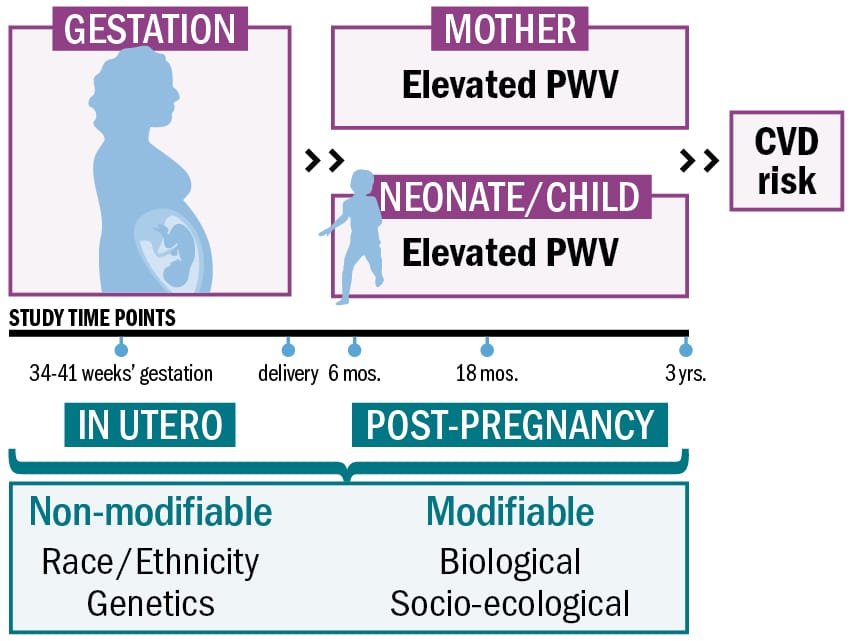
Pregnancy is an opportunity to screen women at high-risk for cardiovascular disease so that prevention strategies can be implemented. Arterial stiffness measured by pulse wave velocity is a marker for cardiovascular disease risk. This study enrolls mother-infant pairs from healthy pregnancies and those complicated by adverse perinatal outcomes to measure maternal and infant arterial stiffness by pulse wave velocity and cardiovascular biomarkers. We will longitudinally estimate cardiovascular disease risk in healthy and medically complicated pregnant women and their infants from birth to three years postpartum.

24/7 Offspring Study
The Offspring Study is a 5-year observational cohort study funded by the National Institutes of Health. This is an extension of our Pregnancy 24/7 Study. In this project, we will examine how 24-hour behavioral patterns (sedentary behavior, sleep, and physical activity) in each trimester of pregnancy is associated with offspring growth and cardiovascular health through 2 years of age. The goal of this work is to identify optimal behavioral patterns during pregnancy to improve future health outcomes for the child.
PRENATAL HEART STUDY
For most pregnant women, regular aerobic exercise — as much as 30 minutes, five days a week — is a recommended part of a healthy pregnancy. A sedentary lifestyle during pregnancy can put both mother and baby at risk for complications such as preeclampsia, which is a significant contributor to cardiovascular disease later in life. However, due to fatigue and discomfort, exercise naturally becomes more difficult in the later months of pregnancy.
This project tests how stretching exercises may be the key to promoting health and preventing complications when pregnant women are starting to feel less mobile. In sedentary, overweight pregnant women with a history of preeclampsia, 10 or more weeks of stretching exercise reduced their risk of preeclampsia by lowering blood pressure and enhancing antioxidant uptake. As many pregnant women from underserved groups are at risk for obesity, stretching exercise is a practical, cost-effective prenatal regimen they can stick with.
Health E Start
The Health E Start Study will explore how lifestyle and environment changes affect heart disease risk factors such as blood pressure, artery health, body composition, blood sugar, and cholesterol in young adults starting college.
Which lifestyle changes (e.g., diet, sleep, and physical activity) increase heart disease risk? Why do these behaviors change during the transition to college? How can we help young adults make healthier choices?
STEP-UP
STEP-UP stands for Short-Term Research Experience Program to Unlock Potential. This Program provides training to high school students under-represented (UR) in exercise, nutrition, cardiovascular, metabolic and related fields to enhance the diversity of the behavioral and clinical research workforce involved in National Institute of Diabetes and Digestive and Kidney Diseases’ (NIDDK) mission-focused research.
Which lifestyle changes (e.g., diet, sleep, and physical activity) increase heart disease risk? Why do these behaviors change during the transition to college? How can we help young adults make healthier choices?
Measurement
My first masters and my doctorate (PhD) had a strong research methodology focus, with a particular emphasis on noninvasive biotechnologies. This focus has been maintained throughout my career, because:
“If you can’t measure it, you can’t improve it.”
This quote is often attributed to Peter Ducket, who was a management guru. Nonetheless, it also applies to scientific research, including research focused on improving human health.
Intermediate Outcomes
When it comes to improving human health, we are typically interested in improving intermediate outcomes rather than a distal clinical endpoint such as cardiovascular disease (CVD) morbidity or mortality. An intermediate outcome (e.g. blood pressure) is a:
surrogate measure for the clinical endpoint of interest.
To be considered an intermediate the outcome should, according to United States Preventative Services Task Force (USPSTF):
reflect a mechanism that is on the causal pathway between an exposure (e.g. pollution or lifestyle intervention) and the clinical endpoint.
Summary of Skills
I had have developed a breadth of skill to facilitate the measurement of lifestyle factors, as well as various physiological systems. My epidemiological/public health work has focused on conventional and novel assessments of cardiometabolic health. In terms of more basic physiology, I have developed the capacity to assess oxygen delivery from the environment to the muscle, blood flow delivery from the heart to the muscle, cardiac structure and function, vascular structure and function, and interactions between vascular function and the immune system.
- Lifestyle. Activity behaviors (sleep, sedentary behavior, standing, physical activity), nutrition, ecological momentary analysis.
- Cardiovascular. Blood biomarkers, blood flow/shear stress, flow-mediated dilation, arterial stiffness (local, regional, central, systemic, gradient), arterial wave reflections, central blood pressure.
- Cerebrovascular. Blood velocity/perfusion, neurovascular coupling, cerebral autoregulation, arterial stiffness.
- Cognition. Computer-based, eye tracking.
- Respiratory. Pulmonary function, maximal oxygen uptake, peripheral oxygen exchange
- Skeletal muscle. Oxygen consumption, mitochondrial function, microvascular blood flow, oxidative capacity, volume, function/strength.
- Body composition. Body fat, lean mass, central adiposity/visceral fat.